The wedding day timeline, the music side, hour by hour.
Your photographer has a timeline. Your venue has a timeline. What almost nobody hands you is the one the music runs on - the run-of-sheet that decides whether the floor fills after dinner or sits there staring at its phones. This is that timeline, built from 35-plus receptions a season: a full timed run-of-sheet, how long each block should actually run, and the timing mistakes that quietly kill a dance floor.
The full reception run-of-sheet, block by block.
This is a working template for a typical 5 PM ceremony rolling into an evening reception - shift the clock to fit your start time, but keep the order and the spacing. The times are real ones I run, not a generic web list. The third column is the part most timelines skip entirely: what the music is actually doing in each block, because a dinner set and a peak-floor set are not the same job and getting the handoff between them wrong is how nights stall.
| Time block | What happens | Music / DJ note |
|---|---|---|
| 5:00 PM | Ceremony | Prelude as guests are seated, processional for the entrance, recessional on the way out. Wireless mic for the officiant and vows so the back row hears them. Keep it simple and clean - this is not the dance set. |
| 5:30 PM | Cocktail hour | Background open-format at low volume while guests mingle and photos happen. Upbeat but conversational - it sets a tone without pulling focus. This is also when the DJ confirms the run-of-show with the venue and photographer. |
| 6:30 PM | Grand entrance | The room is gathered and seated. High-energy track for the wedding party and the couple's entrance - this is the first real spike of the night and the MC carries it on the mic. |
| 6:45 PM | Dinner served | Music drops to a present-but-low dinner set under the conversation. Tempo lifts gradually as plates clear so the room never flatlines between the entrance and the dancing. |
| 7:30 PM | Speeches | Spread across or right after the courses, mic cues and handoffs run by the MC. Soft bed of music between speakers, full cut while someone's talking. Keep the whole block tight. |
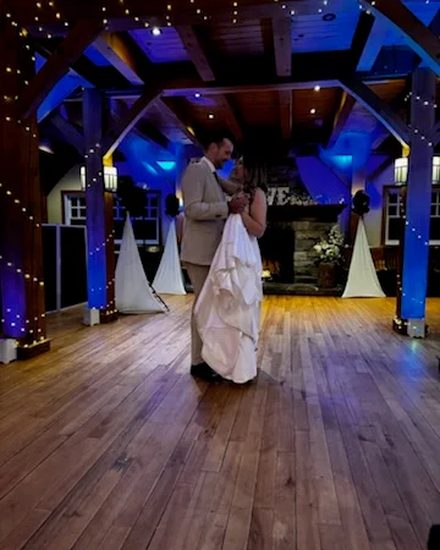
| 8:15 PM | First dance | Straight off the back of dinner while the room is still seated and watching. Their chosen track, clean fade, and the MC invites the floor open the moment it ends. |
| 8:25 PM | Parent dances | Father-daughter and mother-son back to back, or combined into one. Bridge tracks chosen to pull other couples up as they finish so the floor doesn't empty between formal dances. |
| 8:35 PM | Open floor | The night's main event and the longest block by design. Open-format reading the room live - pulling from every era and crowd, swinging genres to keep every age group on the floor. |
| 11:30 PM | Last call | A planned closer everyone knows, the big sing-along that sends people out on a high. The MC thanks the room and points to the exit or the after-party. |
How long each block should actually run.
The order matters, but the durations are where most timelines fall apart - couples either cram the formal moments into a sprint or let dinner and speeches sprawl until the dancing starts an hour late to a half-empty room. Here's the spacing that keeps momentum, with the reasoning, so you can stretch or compress to fit your day instead of guessing.
- Cocktail hour: 45 to 60 minutes. Long enough for photos and mingling, short enough that guests don't get restless and over-served before they've eaten. Past an hour, energy leaks out before the reception even starts.
- Dinner: 60 to 75 minutes. Coordinate the exact window with your caterer - the DJ's dinner set should rise in tempo as it goes so the room is warm, not cold, when the floor opens.
- Speeches: 20 to 25 minutes total. Three or four speakers at five to seven minutes each. This is the single most over-run block at any wedding; brief your speakers on a limit and let the MC hold it.
- First and parent dances: 15 to 20 minutes combined. Keep the formal dances tight and back to back so they flow into open dancing instead of feeling like a separate recital with gaps.
- Open floor: 2.5 to 3 hours minimum. This is the part people remember, so it should be the longest block by a wide margin. Protect it - every minute the earlier blocks over-run gets stolen from here.
Timing mistakes that kill the momentum.
After enough receptions you stop seeing music problems and start seeing timing problems wearing a music costume. A "dead floor" is almost never the wrong song - it's a gap, a stall, or a moment placed at the wrong hour. These are the ones I see derail nights most, and they're all preventable on paper before the day arrives.
| The mistake | Why it kills momentum |
|---|---|
| ✗ A dead gap after dinner | Guests drift to the bar, the smoking area, or the parking lot. Once a room scatters it takes twice as long to pull it back. Roll dinner straight into the first dance. |
| ✗ Speeches that double their time | An unbriefed speaker turns a 20-minute block into 45 and the room's energy is gone before the dancing starts. Set a limit and let the MC enforce it. |
| ✗ Formal dances scheduled too late | Pushing first and parent dances to mid-evening means half the older guests have already left and the moment plays to an emptier room. Front-load them. |
| ✗ Opening the floor on a slow song | The first open-floor track sets the tone. Lead with something nobody can dance to and the floor stays empty; open on a known crowd-filler instead. |
| ✗ Silence during dinner | No music under the meal lets the room flatline. A present, slowly rising dinner set keeps energy warm so the floor doesn't start from a cold stop. |
| ✗ Stacking every formality at once | Entrance, cake, speeches and dances jammed back to back exhausts the room. Space the formal beats so dancing has room to breathe between them. |
The thread running through all of these is the same one that runs through the whole night: one person holding the timeline. When the DJ is also the MC, the music and the mic come from the same head - Sean cues the entrances, paces the speeches, reads the dinner room, and pulls the first dance forward or holds the floor back when the night tells him to. That's what a run-of-sheet can't do on its own. The page is the plan; the read is the part you're actually hiring.
What couples say about the flow.
"We have a really wide range of taste, from house to country to rap to oldies, and he nailed every single one."
"Communication was seamless, he understood exactly the vibe we wanted, and he had everyone on the dance floor all night."
Wedding day timeline FAQ.
How long should a wedding reception be?
Most receptions run five to six hours from grand entrance to last call, and that's the sweet spot. Budget roughly an hour for cocktails before dinner, an hour to ninety minutes for dinner and speeches combined, and at least two and a half to three hours of open dancing after that.
Anything shorter than two hours of dancing and the floor never really gets going; anything past midnight and you're paying for a room that's slowly emptying. Build the night so the longest single block is the open floor, because that's the part people actually remember.
When should the first dance happen at a wedding?
The strongest move is to put the first dance right after dinner, the moment the meal winds down, and roll straight from it into open dancing. People are already seated and watching, the room is warm, and you've got their full attention without having to gather them twice.
Doing the first dance immediately after the grand entrance can also work if you want the formal moments out of the way early, but the after-dinner slot is the one that bridges cleanly into a packed floor. The worst option is a long gap after dinner where guests drift to the bar or the parking lot before anything happens.
How long should wedding speeches be?
Keep the whole speech block under 20 to 25 minutes total, which usually means three or four speakers at five to seven minutes each. Speeches are where a reception loses momentum faster than anywhere else, so brief your speakers on a time limit and have the MC hold the line gently.
Spreading speeches across the dinner courses instead of stacking them all at once keeps energy up and gives the kitchen room to work. As the DJ and MC, Sean cues each speaker, manages the mic handoffs, and keeps the block moving so it doesn't stall the night.
What are the biggest wedding timeline mistakes?
The big three are a dead gap after dinner before dancing starts, speeches that run twice as long as planned, and scheduling the formal dances too late once half the guests have left. Letting the meal drag without music, opening the floor with a slow song nobody can dance to, and forgetting to feed the dinner crowd a clear transition cue are the next tier.
Almost every momentum killer is a timing problem, not a song problem. The fix is a tight run-of-sheet, a firm hand on the speech block, and a DJ who can pull a moment forward or hold it back when the room tells them to.
Should the DJ play music during dinner?
Yes, always. Dinner music should be present but low, sitting under the conversation rather than competing with it, and it does more than fill silence. It sets the tempo of the room, keeps energy from flatlining between the entrance and the dancing, and lets the DJ slowly lift the volume and tempo as plates clear so the open floor doesn't start from a cold stop. Sean reads the dinner crowd and times that lift to land right as the meal ends, so the transition into dancing feels like one continuous build instead of a hard restart.
Let's build your run-of-sheet together.
Live calendar, quick call, no deposit to talk. Bring your venue's start time and we'll map the music side end to end.
Check your date ▸ Text or WhatsApp me Call 604 968 7078More: Wedding MC script template How to choose a wedding DJ Wedding DJ Ottawa All guides Home · Wedding DJ Cost Wedding MC for hire Reviews DJ mariage Gatineau
From the booth
Photographers give you a shot list, venues give you a room schedule, but nobody hands you the music run sheet that keeps the floor alive. That is what I build from thirty plus weddings a season, and I want you to see the real hour by hour flow from the booth side.
Good questions
How early do you get to the venue before the ceremony starts?
I aim for ninety minutes ahead if I am covering both ceremony and reception in one space. That gives me time to load in, test every wireless mic, and have music playing as soon as the first guest walks in.
What happens if the dinner runs long and dancing gets pushed late?
I begin lifting the dinner music tempo about ten minutes before dessert clears, so the room never flatlines. Then I shorten the first slow dance and go straight into a solid block of high energy, no fluff.
How do you make sure the grand entrance actually lands hard?
I spend the last five minutes of cocktail hour confirming names and order with the planner, then I kill the background music for a brief silence before the entrance track drops. That little pause tells the whole room to pay attention.
The silence between the last dinner plate and the first dance track is where I see floors die. I never let that gap happen, even if I have to play a quiet filler while the mic is still hot from toasts.