How to choose a wedding DJ without getting burned.
Most "how to choose a wedding DJ" advice is written by people who have never run a reception. This isn't. After eight-plus years and 35+ weddings a season, here is what actually separates a great wedding DJ from a guy with a laptop - and the green flags, red flags, and quote breakdown to look for before you sign.
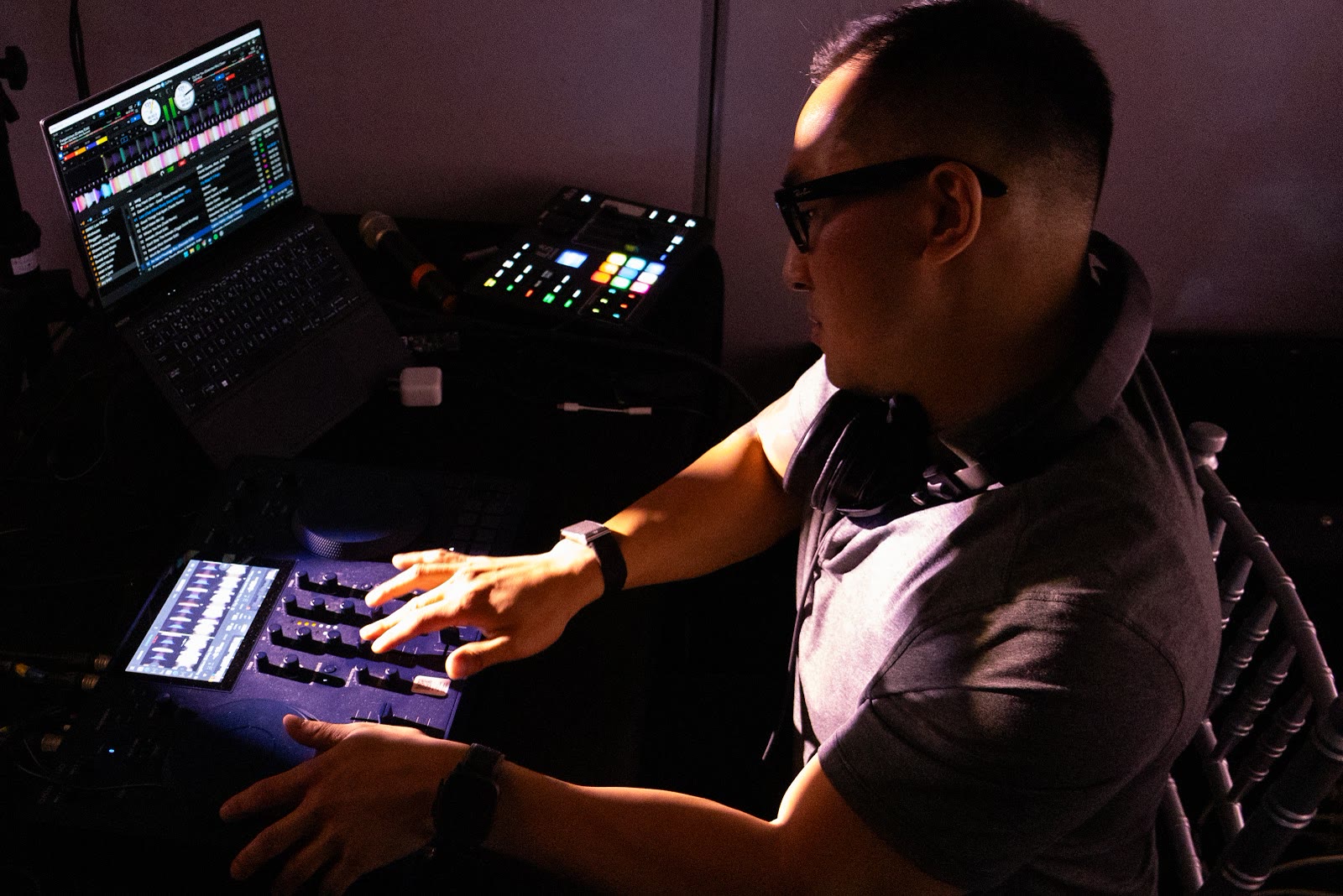
What actually separates a great DJ from a guy with a laptop.
Almost anyone can build a playlist and press play. The thing you are actually paying for is the part that happens when the playlist is wrong - when half the floor sits down after dinner, when the maid of honour's speech runs ten minutes long, when a cable dies during the first dance. That is the difference, and it never shows up in a song list. Here is the honest short list of what to weigh, roughly in order of how much it matters.
- Reading the room. The single biggest skill, and the hardest to fake. A real wedding DJ watches who is on the floor and adjusts in real time - they do not run a pre-baked playlist and hope. Ask one directly how they'd handle the floor emptying after dinner. A vague answer is your answer.
- Open-format range. Your wedding is not one genre. A good DJ can swing from a francophone aunt's request to a Bollywood set to late-night hip-hop without clearing the floor. Narrow DJs are great in a club and a liability at a wedding.
- MC ability. Someone has to run the timeline, cue the entrances and speeches, and keep the night moving without dead air. A DJ who can also MC means the music and the mic come from the same head - no awkward handoff to a separate host who has never met your DJ.
- Professional backup gear. This is the boring one that saves your reception. Ask if they carry a backup controller, spare speaker, and redundant cables. A weekend DJ owns one of everything; a pro owns two, because gear fails and the show cannot stop while it does.
- A real contract and insurance. A signed contract that names the actual person showing up, plus liability insurance - which many venues now require anyway. No contract is the loudest red flag there is.
Green flags vs red flags.
Print this and run any DJ you're considering through it. The left column is who you want; the right column is who shows up to a reception with one speaker and a Spotify Premium account.
| Green flags - book this person | Red flags - keep looking |
|---|---|
| ✓ Asks about your crowd, your venue and your timeline before talking price | ✗ Quotes one flat number before knowing anything about your day |
| ✓ Carries backup gear - second controller, spare speaker, redundant cables | ✗ "One of everything" and no answer when you ask what happens if gear fails |
| ✓ Can MC and read the room, with examples of adjusting a set live | ✗ Talks only about their equipment and their lights, never your guests |
| ✓ Itemized written quote and a contract that names the actual DJ | ✗ Vague verbal price, no contract, or a "DJ assigned later" agency |
| ✓ Has liability insurance and has worked your kind of venue | ✗ No insurance, or has never done a wedding-format event |
| ✓ Replies clearly and on time during the booking conversation | ✗ Slow, vague replies now - which is exactly how they'll be on the day |
| ✓ Reviews that mention timing, MC work and a full floor, not just "nice music" | ✗ No reviews, or only "good vibes" with nothing about running the night |
The booking timeline, month by month.
Couples get this backwards constantly - they finalize the playlist early and book the DJ late, when it should be the reverse. For a summer Saturday in Ottawa the best DJs are gone 9 to 12 months out. Lock the person first, build the details later. Here's the cadence that works.
| When | What to do |
|---|---|
| 12 months out | Research and shortlist. Get on calls, ask the room-reading and backup-gear questions, and put a hold on your top pick once your date and venue are locked. Don't wait for the season to fill. |
| 9 months out | Sign. Get the itemized quote and a contract that names the actual DJ, pay the deposit, and stop your search. For peak Saturdays this is the real deadline, not a suggestion. |
| 6 months out | Build the timeline together. A good DJ runs a planning call to map the entrances, dinner, speeches and dances, and to coordinate with your venue and photographer. |
| 3 months out | Finalize the music. Must-play list, do-not-play list, first-dance and parent-dance tracks, and any cultural or bilingual moments. Confirm load-in time with the venue. |
| 2 weeks out | Final confirmation call. Lock the run-of-show, confirm contact on the day, and hand off any last song changes. After this, you stop thinking about it. |
What a real wedding-DJ quote actually includes.
A real quote is itemized, not one mystery number. You should be able to see exactly what you're paying for and add or drop pieces. A floor of $1,500 CAD is a "let's still talk" number for a lean day, but most full weddings land higher once MC, a system sized to your guest count, and a planning call are in. Below is roughly how the pieces stack up - ranges, because a 60-guest backyard and a 200-guest ballroom are not the same job. HST of 13% applies on top.
| Line item | What it covers | Typical range (CAD) |
|---|---|---|
| DJ base floor | Entry-level coverage for a small, simple day - non-disqualifying, a "let's still talk" starting point | from $1,500 |
| DJ coverage tiers | Full reception coverage, MC duties, sound system sized to your guest count, and a planning call - priced by hours and scale | $1,500 to $2,800 |
| Uplighting | Room wash that transforms a plain hall - add-on, listed separately | around +$250 |
| Core package | DJ + MC + sound, coordinated under one contact for the whole night | $1,500 to $1,900 or $2,200 to $2,800 |
| Full Floor package | The complete reception build - DJ, MC, sound and lighting working together | $2,900 - $3,600 |
| Whole Night package | Full Floor plus photo and video, coordinated through one point of contact | quoted on request |
The reason the packages exist is simple: one contact for the whole night. DJ, MC, lighting and the photo booth coordinated by one person means nothing falls in the gap between vendors who met for the first time at your wedding. If a quote you're comparing is a single flat number with no line items, ask for the breakdown - what you can't see is usually where the corners get cut.
How to actually run the comparison.
Once you've got two or three DJs that clear the green-flag list, the choice usually comes down to a side-by-side. Don't compare the headline prices - compare what's inside them. Line the itemized quotes up next to each other and check that you're weighing the same coverage hours, the same gear, and the same MC scope, because a "cheaper" DJ who doesn't include ceremony sound or a second speaker isn't actually cheaper.
Then weight the two things that don't show up on a quote at all: how fast and clearly each person replied during the booking conversation, and whether their reviews mention timing and a full floor rather than just "nice music." When two quotes are close, the tiebreaker is almost always the person, not the package.
- Normalize the quotes first. Put coverage hours, ceremony sound, lighting and backup gear in the same columns before you look at the totals - otherwise you're comparing a full reception against a stripped one.
- Score responsiveness. The DJ who answers clearly and on time while chasing your booking is the DJ who answers clearly on the day. Slow now is slow then.
- Read the reviews for verbs, not vibes. "Kept the floor full," "ran the timeline," "handled the speeches" tell you more than five stars and "great guy."
Couples, on the record.
"We have a really wide range of taste, from house to country to rap to oldies, and he nailed every single one."
"Communication was seamless, he understood exactly the vibe we wanted, and he had everyone on the dance floor all night."
Choosing a wedding DJ FAQ.
How do I choose a wedding DJ?
Start with the things a laptop and a playlist can't fake: does this person read a room, can they MC the formal moments, and do they carry backup gear so one dead cable doesn't kill your reception. Get on a real call, ask how they'd handle your specific timeline, and listen for whether they talk about your guests or about their equipment. Then check that the quote is itemized, the contract names the actual person who shows up, and they carry liability insurance. Book the date once those three things check out.
How far in advance should I book a wedding DJ?
For a summer Saturday in Ottawa, the good DJs are gone 9 to 12 months out, sometimes more. The honest answer is: book as soon as your date and venue are locked. Twelve months out you research and hold; nine months out you sign; six months out you build the timeline together; three months out you finalize the must-play and do-not-play lists. Short notice can still work, so check the date either way - but don't assume the calendar is open just because it's early.
What separates a great wedding DJ from a cheap one?
Reading the room. A cheap DJ presses play on a playlist and hopes; a great one watches who's actually on the floor and adjusts in real time, pulling a moment forward or holding it back. The other big gaps are open-format range (can they swing from a francophone aunt's request to a hip-hop set without the floor clearing), real MC ability, professional backup gear, and a proper contract with insurance. The price difference is usually the difference between someone who does this 35-plus times a year and someone who does it occasionally.
What should a wedding DJ quote include?
An itemized quote, not one round number. It should show the DJ coverage hours, MC duties, the sound system for your guest count, a planning call to build the timeline, backup gear, and travel if your venue is out of town. Add-ons like uplighting (around +$250) or a photo booth should be listed separately so you can see what you're paying for.
Sean's DJ coverage typically runs in the $1,500 to $2,800 range, with complete packages with lighting and a photo booth from roughly $2,900 to $3,600 depending on what's included. HST of 13 percent applies on top. If a quote is just one vague number with no breakdown, that's a red flag.
Is it worth paying more for a wedding DJ?
The DJ is the one vendor who controls how the whole night feels in real time - the photos are seen later, the food is eaten and gone, but the dance floor is the memory people leave with. Paying more usually buys experience, real backup gear so technical failures don't end the party, and someone who can MC and read the room instead of just playing tracks.
That said, price isn't a guarantee on its own; a $1,250 DJ who reads the room beats a $3,000 one who doesn't. Match the spend to whether the person can actually run your specific night.
Run me through your own green-flag list.
Live calendar, quick call, no deposit to talk. Ask the hard questions - that's the point.
Check your date ▸ Text or WhatsApp me Call 604 968 7078More: Questions to ask a wedding DJ Wedding DJ vs band Wedding DJ cost Wedding DJ Ottawa Wedding MC Ottawa All guides Home Reviews DJ mariage Gatineau
From the booth
I watch a lot of DJs show up to a venue with just a laptop and one speaker. That is fine until something goes sideways, and then the whole room feels it. When you compare DJs, look past the playlist and ask who you want on the mic when the timeline hits a bump.
Good questions
What actually separates a great wedding DJ from someone who just plays music?
A great DJ reads the floor and adjusts in real time instead of running a pre-baked playlist. If they cannot describe how they handle a room that empties after dinner, they probably cannot fix it.
Do we need our DJ to also handle the MC duties?
It helps a lot. When the same person runs the music and the mic, the timeline flows without awkward handoffs. You get a more cohesive night and no dead air between events.
Should we really ask a DJ about backup equipment?
Yes. I carry a spare controller, extra speaker, and redundant cables because gear fails and your reception cannot pause while someone runs to a store. A DJ who does not take that seriously is a risk.
A seasoned DJ also watches the bar line, not just the dance floor. If the floor thins out, I check if the bar just opened a fresh round, because people often drift back once they have a drink. That kind of quiet read keeps the night steady.